

Surprisingly for a film that finds its inspiration in one of the more insipidly memed-upon staples of amateur internet horror media, Backrooms was released in May 2026 to an overwhelmingly positive reception. In a milieu where franchisification looms large on the horizon of every narrative concept that has the misfortune of falling into the realm of internet notoriety, Backrooms’ greatest success was to navigate the transition from popular culture to Intellectual Property™ in a manner that provided a coherent narrative from start to finish that, on a diegetic level, is internally consistent and narratively sensical.
This is perhaps 20-year-old directorial debutante Kane Parsons’ biggest accomplishment, and indeed the most genuine compliment I will allow myself to concede to the film: it coheres. Plot threads weave together nicely, the questions left unanswered are the ones that the audience is meant to mull over on their way home after the cinema, and everything left unsaid is surrounded by enough contextual points of attachment that it might reasonably be extrapolated. The film is jarring only in ways it intends to be. You can watch it, so it goes, and come away from it having experienced a reasonably entertaining story that is both thematically and narratively sure of itself.
The glaring issues with Backrooms begin to surface when the viewer escapes the confines of the film’s internal logic and engages hermeneutically with it as an object that belongs to a lineage of other objects – a socio-political product that invariably boasts myriad attachments (many of which I would argue to be malignant) to a wider cultural corpus that inflect it with deeper contextual meanings.[1] On one hand, this corpus lends itself to a forgiving review of a young director’s professional debut, given that it happened in a world of endless franchise sequels, remakes, and adaptations of adaptation seemingly more concerned with brand name marketability than an interesting mobilisation of the cinematic medium to tell a good story. The idea that Parsons’ take on an internet meme (which I will fain call a sort of collectivist act of digital cultural storytelling entirely at odds with the mechanisms of IPs) might have spawned a self-contained and reasonably sensical progression of narrative beats becomes much more impressive to a viewer than it arguably is.
If one is to be blunt, then the thing that makes the Backrooms a ‘bad film’ is its overwhelming reliance on the racist casting of its single black character as the ultimate progenitor of violence enacted in the film, and an almost fetishistic obsession with the suffering of white women. Our deuteragonists are Clark, a violent alcoholic who runs a failing furniture shop, and Mary, his therapist. Despite the fact that of the two, Clark is a proactive agent whilst Mary is passive and reactive, we are meant to take Mary as our unambiguous protagonist; the IMDB tagline for the film tells us that ‘[a]fter a therapist’s patient disappears into a dimension beyond reality, she must venture into the unknown to save him’.[2] This framing is explicit in its assignment of narrative importance, never mind that Mary only undertakes such an action well past the halfway point of the film once Clark has already provided her with detailed maps of the Backrooms (twice).
This disavowal of Clark as a central protagonist of the film is perhaps the least symptom of the film’s deeper rot: this film is racist. Inalienably so. Clark is the only Black character in the cast, and the film wastes no time in casting him as aggressive. The first time we meet him, in a therapy session with Mary, he reveals three things about himself in quick succession: he has been kicked out of his own house, because he is a failed architect who has turned to drink to cope with that, and he is a belligerent and abusive drunk. He mocks and ridicules his wife’s commitment to law school whilst he fails to run his furniture store profitably; he holds money over her head. Clark’s wife, pertinently, is a white woman. Here is our first impression of our plot’s catalyst and our only character of colour: he already has a white victim.
The story of Backrooms is this, abridged: in his furniture store, where he now lives as he has been made otherwise homeless, Clark finds a doorway to the ‘backrooms’, an uncanny alternate dimension that is inhabited by some unseen, yet threatening, ‘thing’.[3] He escapes it, but becomes fascinated by the backrooms – he begins to map them. He attempts to tell Mary about this, but hesitates (she assumes he’s merely mentally unwell); her disbelief galvanises him to bring his two employees with him to film the setting, but they are killed – the man (Bobby) unambiguously, the woman (Kat) offscreen. Clark sends Mary a voicemail that he is going to live in the backrooms, Mary comes to find him, and Clark is revealed to have become entirely psychotic – perpetuating, naturally, the stereotype of the dangerous and violent schizophrenic black man.[4] He captures and restrains Mary, and after showing her Kat’s head in a freezer to ensure we make our misogynistic spectacle slightly more vibrant, he shows Mary that this world is inhabited by misremembered, dubiously sapient facsimiles of real people and demonstrates an unhinged level of violence by cutting a pound of flesh from one and eating it.
After some thematically relevant abused-wife roleplay with the captive Mary, she snaps and tells Clark that he is a bad person in what is clearly meant to be a liberating moment for her but instead reads as the utter condemnation of, I must stress again, this entire film’s singular Black character as irredeemably, inalienably, and inherently malignant. Our monster reveals itself – a parody of Clark as his furniture store’s mascot comes shambling in – and, galvanised by Mary’s shedding of her role as the patient therapist and subsequent rebuke, he tries to reason with his own facsimile, culminating in his final words. ‘Didn’t you hear her?’ he says. ‘We don’t have to change. It’s just the way we’re wired.’ The facsimile, looming larger than life, and sporting a grotesque play of black features made stupid, uncomprehending, and violent, begins to eat him.
The end of the movie is an extended chase sequence through the backrooms, as our remaining battered woman is pursued through the backrooms by a violently cannibalistic caricature of a Black pirate that marries together the racist stereotype of the Brute popular during the time of chattel slavery with further racist conceptions of Black stupidity or unintelligence.
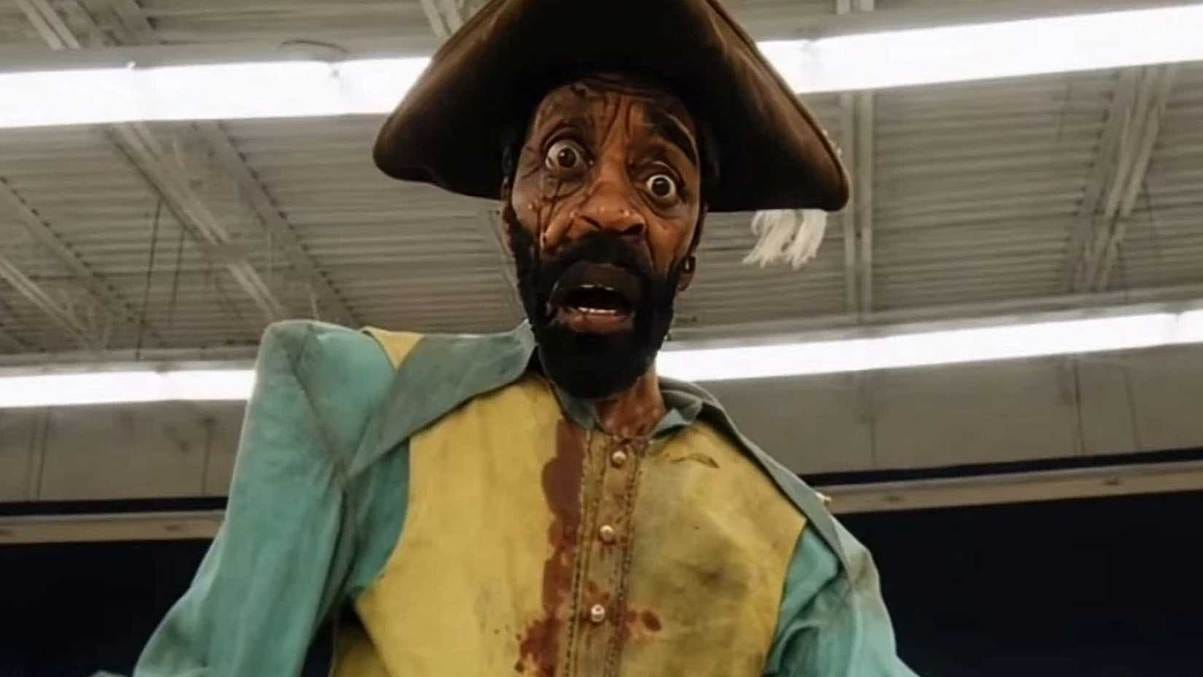
Figure 1: Clark’s facsimile, grotesque, looming, and stupid, with the blood of his victim trailing down his shirt.
Mary escapes, bashing Clark’s head in with a concrete handprint serving as a memento of her own abusive childhood, but is unable to finish her escape alone. Rather, she is found and institutionalised by the miscellaneous scientists intermittently seen observing the phenomenon of the backrooms. The story ends with us being shown a shot of Mary’s own facsimile in the Backrooms – unlike Clark’s violent and crazed caricature, Mary’s is still and silent, sitting as though restrained, a monument to her captivity.
This is ending to Backrooms: a narrative of Black violence against white woman being remediated by white violence against the Black man and his caricature. I am not the first to make observation, and nor will I be the last. However, in a milieu that seems more concerned with praising the film for its representation of an indie filmmaker in the blockbuster market, or the impressive execution of the backrooms environment (the ability to appreciate this is regrettably inversely correlated with the amount of random modifiers you’ve every messed around with in Blender), or the charming surprise that a film based on a 4chan creepypasta fails to disappoint the viewer, I believe that elaboration on this point is critical. The lacunary criticism around the film fails to alight upon the critical fact that it is explicitly racist and hostile to the Black figure, and in doing so endorses this representational violence.
Particularly irritating in this context is Peter Bradshaw’s five-star guardian review of the film, where he refers to Mary as a ‘sad, gentle person’ who is ‘haunted’ by the spectre of her abusive mother, whilst Clark is a ‘failed architect, separated from his wife’ – he is ‘an alcoholic who … self-hatingly manages a drearily and eerily vast discount furniture store’ and does ‘dumb TV ads dressed as a pirate’ and is ‘uneasily aware’ that this doesn’t cohere with his own theming.[5] Bradshaw’s reproduction of the innocent white woman and endlessly criticisable, failing, foolish Black man aligns his review perfectly with Backrooms’ unaddressed racial biases. Unacknowledged entirely in this castigating reification of white female victimhood and Black male volatility is the dynamic of power that Mary holds over Clark as a practicing therapist.
After his initial discovery of the backrooms, Clark frenetically bursts into her office and asks if she’s ever 5150’d someone. Despite his fascination with the backrooms, his initial reaction – as is the good psychiatric patient’s – is to attempt to disclose his encounter to his therapist. However, Clark’s attempts at obedience come into tension with an awareness of his positionality, demonstrating an awareness that if he discloses the wrong thing or says something to Mary that aligns him too closely with psychosis, he will experience material harm. Clark’s question draws explicit attention to the power differential between Mary and Clark that the rest of the film seems unwilling to acknowledge. Mary may be gentle in her manner, but she also has an implicit carceral power that she can choose to deploy at will.
Her response to Clark’s implied question – ‘if I tell you about this, will you subject me to a carceral state apparatus?’ – is hedged, but clear. She might. She has done so before. She makes justifications that fall intentionally flat, invoking the spectre of harm to oneself and others, but ultimately, the psychiatric apparatus as an axis of repression remains a tangible pressure whose looming presence cannot be sufficiently neutered by the film’s tacit ideological alignment with it. In her therapeutic role, Mary makes Clark engage in exercises that humiliate him ‘for his own good’, having him re-enact the drunkenly belligerent confrontation between him and his wife that leads to his expulsion from his house, and yet when Clark has Mary go through these motions during captivity we are expected to sympathise with the notion that the context is disturbing and discomforting for her.
The intent of this scene is to allow Mary to shed the role of psychiatric authority and don the role of the victim – presumably so that her subsequent condemnation of Clark’s psyche can be more easily read as a liberating moment rather than a final edict from a neutered authority figure – but it also demonstrates a more sinister dynamic. Clark is expected to submit to this process of play-acting; never mind that he doesn’t want to be there, never mind that it makes him feel stupid. When the same treatment is applied to Mary, it is an act of abuse done in the context of an explicit captivity. Yet, Clark is ostensibly equally trapped in her office, before he has gone and proven himself true to the stereotype of the schizophrenic Black man, because he already reproduces a violent Black male archetype who thanks to his belligerence must be subject to this treatment whether or not he wants it. I’m given to understand that the dual roles of psychiatrist/victim and patient/perpetrator are common horror tropes, but I believe that in this case, the implications are more sinister. For Mary, a victimised white woman, being stripped of her autonomy and being placed into a psychiatric context against her will is an explicit act of violence. It is implied to us that for Clark, submission would have spared him his spiral into madness. It is his choice to leave that damns him.
Backrooms is an indescribably racist film. The horror that lies at the heart of Parsons’ reimagining of a tired internet cliché is the notion of Black autonomy, and the fact that this has been consistently elided in critique and reviews of the film suggests a worrying societal acceptance for depictions of outright racism in our mainstream media. Backrooms’ immersive special effects, the affectivity of the horror, or the impressiveness of the soundtrack, or the cohesiveness of the film’s narrative may net it a status as a film that is technically impressive, but this should all be rendered unenjoyable in the face of its commitment to reproducing centuries of racist propaganda uncritically, as its underlying narrative lynchpin. The title of this article – Backrooms is Not a Bad Film, which is Weird Because it’s a Really Bad Film – is an iteration of the crux of this criticism voiced by Charles Preston on Tw*tter, which I will conclude with, as he summarises the matter far more neatly and succinctly than I ever could:
Backrooms is racist film. It’s technically brilliant, but racist. And it’s a shame during a time where Black studies is being eliminated on college campuses because I fear people are overlooking the obvious tropes and racist callbacks the film ridiculously displays.[6]
[1] This is an oblique reference to rather than a true critical mobilisation of this concept, but this comment owes itself to Bruno Latour’s theorising of attachments and the ‘factish’ (don’t laugh pleaaaase) after ANT. Bruno Latour, ‘Factures/Fractures: From the Concept of Network to the Concept of Attachment’, trans. by Monique Girard Stark, Res Anthropology and Aesthetics, 36 (1999), 20–31.
[2] IMDB, ‘Backrooms’, 2026 <https://www.imdb.com/title/tt26657236/> [accessed 22 June 2026]
[3] Considering the reveal of what our ‘final’ monster is, one has to wonder what it was that threatened Clark and our prologue’s ill-fated feature.
[4] I know I don’t actually have to explain this one, since it is obvious, but this is multiply insulting considering the disproportionate rates at which Black patients are categorised and disenfranchised under the schizophrenia diagnosis. I am nonetheless going to cite a source here, mainly because I think it’s a really insightful one on the history of Blackness and schizophrenia: Jonathan M. Metzl, ‘The Protest Psychosis & the Future of Equity & Diversity Efforts in American Psychiatry’, Daedalus, 152.4 (2023), 92–110.
[5] Peter Bradshaw, ‘Backrooms Review – Kane Parsons’ Icily Disturbing Horror Rewrites the Genre Rulebook’, The Guardian (The Guardian, 27 May 2026) <https://www.theguardian.com/film/2026/may/27/backrooms-review-kane-parsons-icily-disturbing-horror-rewrites-the-genre-rulebook> [accessed 22 June 2026].
[6] @_CharlesPreston, 3 June 2025, X (Formerly Twitter) <https://x.com/_CharlesPreston/status/2062155401060036989> [accessed 22 June 2026].
I think your critiques of the film as racist are more about how our society receives and interprets Black anger, mental illness, and “madness,” than they are about the film’s racist casting.
I think, personally, that it is more so that we live in a social-historical climate that reads the aspects of Clark’s character through a lens of racism. The critique for me may be that the director and screen casters should have been cognizant of how these things may be interpreted/read through the film; but at the same time, is that a critique of the film itself? I think not.
I would like for us to be able to consume a film where a Black man can play the role of perpetrating harm to a white woman and not have it read as inherently rooted in Jim-crowism. I also realize that such is not the world we live in. I also don’t think that when it happens it means that the film itself is racist.
i’m sorry but just because there is a movie, and in the movie, there is a black man, and he’s not a good person, doesn’t mean the movie is ultimately racist at all… that’s a very empty claim. people can’t strive for black exclusivity and then get mad and criticize every role they’re chosen in and get offended when the black man/woman isn’t portrayed as perfect. it has absolutely nothing to do with race. the movie wasn’t a black vs white battle and i think you missed the point a little by focusing too much on their races, but i hear your opinion about the movie in general.